
IIMS Journal of Management Science

 Search

Sivaranjan Murugesan1
1 Marketing Department, Anna University, Chennai, Tamil Nadu, India

Creative Commons Non Commercial CC BY-NC: This article is distributed under the terms of the Creative Commons Attribution-NonCommercial 4.0 License (http://www.creativecommons.org/licenses/by-nc/4.0/) which permits non-Commercial use, reproduction and distribution of the work without further permission provided the original work is attributed.
The usage of Celebrity endorsers in brand advertising has become popular since the presence of a celebrity endorser is likely to positively influence the consumer to buy their products. Marketers expect that the celebrity’s endorsement will create an emotional tie to the product/brand and his/her good attributes will be transferred to the brand. Our research has focused on the impact of celebrity advertisements on consumers using sentiment analysis. Our objective was to use sentiment analysis to calculate the sentiment scores of advertisements with celebrity endorsements. We used four celebrity-endorsed advertisements and collected responses/reactions from consumers. The advertisement responses were analysed using ‘sentimentr’ for endorser congruence and endorser frequency conditions. The findings revealed that brand-endorser congruence and highly frequently appeared endorsers have received high sentiment scores. This research has shown that marketers need to choose brand-congruent and highly frequent endorsers for creating advertising impact.
Celebrity endorsements, sentiment analysis, endorser congruency, endorser frequency
Introduction
Marketers are facing the challenge of attracting the consumer’s attention through their advertising efforts in a crowded media environment. A widely used method in advertising to break the clutter and get the attention of consumers is the use of celebrity endorsers (Doss, 2011). Celebrity endorsement has now become a globally popular advertising and marketing strategy (Knoll & Matthes, 2017). A celebrity endorser is defined as ‘anyone who enjoys public recognition and who uses this recognition on behalf of a consumer good by appearing with it in an advertisement’ (McCracken, 1989). Therefore, the meaning attached to the celebrity can become associated with the brand through endorsement (Miller & Allen, 2012). A celebrity can be a person well-known in one of a wide variety of fields such as science, politics, sports or entertainment (Chia & Poo, 2009). Celebrities have now become the face or image of brands they endorse. Celebrity endorsers can be used to launch a brand, maintain and reinforce a brand’s competitive position and in repositioning brands (Pringle, 2004). The usage of celebrity endorsers in brand advertising has become popular since the presence of a celebrity endorser is likely to positively influence the consumer to buy their products (Stafford et al., 2003). Celebrity endorsers may take on the role of spokesperson on behalf of the company, expert in the product field or as a model to which the consumer base aspires (Seno & Lukas, 2007). Marketers spend huge sums of money for getting celebrities to endorse their brands with the hope that celebrities will be effective spokespersons for their brands (Yang, 2018). Marketers expect that the celebrity’s endorsement will create an emotional tie to the product/brand and his/her good attributes will be transferred to the brand (Kim et al., 2018). Marketers also feel that the endorser’s popularity will break the clutter in media, and the message from the endorser will be trusted as he has no self-interest in the product coupled with the belief that the endorser loves the brand and that is the reason, he has consented to endorse it (Seitz et al., 2007). Previous research on celebrity endorsers has found that employing celebrities in advertisements has had a positive impact on brand attitudes (Till et al., 2008), brand awareness (Miller & Laczniak, 2011), attitudes towards advertisements (McCormick, 2016) and purchase intent (Chung & Cho, 2017).
Theoretical Background and Research Hypothesis
Several models have been proposed to explain the effectiveness of celebrity endorsement. Previous research on celebrity endorsements has been extensive (Erdogan, 1999) and has led to four main models to describe the impact: the source credibility model, the source attractiveness model, the congruence or match up model and the Meaning transfer model. The source credibility model proposes that the expertise and trust in the endorser will influence the attitudes of consumers towards the advertised product (Kamins, 1989). The physical attractiveness of the endorser was seen as the catalyst for influencing consumer attitude in the source attractiveness model (Till & Busler, 2000). The match–up model proposes that a fit between the endorser and product is required to influence consumer attitudes (Kamins, 1990). McCracken (1989) suggested that celebrities represent a set of meanings to the consumer and these meanings were transferred to the brand advertised by his endorsement. Previous research in the area of celebrity endorsements has largely adopted the experimentation approach to test the effect of endorsers on consumer attitudes. According to Knoll and Matthes (2017), advertising attempts to influence the consumer at three levels–the cognitive, affective and conative levels. Our research has focused on the effect impact by using sentiment analysis of consumer responses to celebrity advertisements.
Sentiment analysis also called Opinion Mining is one of the recent emerging areas of research in Information Processing (Serrano-Guerrero et al., 2015). Several techniques and software tools have been developed to analyse people’s attitudes, opinions and views on a wide range of topics such as products and services as well as individuals. The text contains not only factual content but also a subjective component which can be emotions and attitudes. The main objective of sentiment analysis is to determine whether a text is subjective and if so, does it present a positive or negative view (Taboada, 2016). Marketers have taken to tracking online consumer reviews of their products on e-commerce websites and using sentiment analysis techniques to understand what is the sentiment (positive/negative) about their products. Our objective was to use sentiment analysis to calculate sentiment scores of celebrity-endorsed advertisements. Our review of the literature has revealed that the usage of sentiment analysis to understand the impact of celebrity endorsers in advertisements has not been examined.
Previous studies have focused on under what conditions celebrities are appropriate for products. The ‘match-up hypothesis’ (Kamins, 1990) has proposed that celebrity advertisements create an impact when there is a ‘fit’ between the endorser and the endorsed product. Congruence in celebrity endorsements has been defined by Misra and Beatty (1990) as a context where ‘the highly relevant characteristics of the spokesperson are consistent with the highly relevant attributes of the brand’. Since they did not define what are the relevant characteristics, subsequent research studies were centred on identifying them. Several research studies on the match-up hypothesis have concentrated on a match between the physical attractiveness of the endorser and the brand. For example, a physically attractive film actress endorsing a beauty cosmetic. Expertise, credibility trustworthiness, personality and self-image have also been examined in this context.
Logically there must be a fit between a celebrity endorser’s characteristics (for example, familiarity and expertise) and the brand. When the endorser and the endorsed product match the consumer’s brand attitude is favourable. For example, for an athlete endorsing a sports shoe, there is a match and if he is seen endorsing an ice cream, there is a mismatch. This degree of congruence between the brand and the celebrity represents the main criteria for selecting a spokesperson (Erdogan et al., 2001; Rice et al., 2012). Congruence is an area that requires further research by academics (Um, 2018). When there is congruence between the celebrity and the brand there will likely be positive evaluations of the brand and endorser. This leads us to our hypothesis:
H1: There will be a significant difference in sentiment scores for celebrities and brands with high congruence than those with low congruence.
The effectiveness of endorsement depends on the consumer’s relationship strength with the celebrity. The level of endorsement frequency by celebrities tends to be different. Consumers are exposed to celebrity endorsements several times in different media like television, print, radio, outdoor and on social media. When consumers interact frequently with celebrities across these media, they develop a stronger relationship with high-frequency celebrities (Klimmt et al., 2006). Celebrity endorsements can be viewed as using the classical conditioning route and greater pairings may lead to stronger effects (Chen et al., 2012). The usage of celebrity endorsement through television and social media will increase the effectiveness of both endorser and endorsed object (Freiden, 1984; Petra, 2009).
Endorser advertisement broadcasted concomitantly on television and social media will tend to increase the relationship between the endorser and the viewers (Chung & Cho, 2017). The high-frequency of contemplating an advertisement will increase the awareness of the endorsers (Rubin & Hugh, 1987). The use of celebrity endorsement through multiple communication medium will increase the attention of viewers towards the endorser (Leets et al., 1985). The high interaction frequency will spiral the relationship between viewers and celebrity (Aw & Labrecque, 2020). Effective endorser will have a good relationship with the consumers (Ilicic & Webster, 2011). Frequent appearance of the celebrity endorser will escalate the feelings of consumer towards the celebrity (Wood & Burkhalter, 2014). Thus, the celebrity endorser will surge the purchase intention and the brand attractiveness (Kahle & homer, 1985). This leads to our second hypothesis:
H2: There will be a significant difference in sentiment scores of celebrities whose frequency of endorsement is high than low.
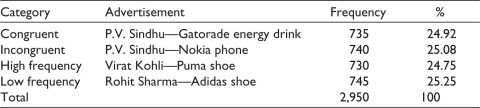
In this research, we have attempted to study the ‘match–up’ (congruence) effect using a sports person (P.V. Sindhu) and a Gatorade energy sports drink advertisement. We have also used the same endorser advertising for an incongruent product—the Nokia smartphone. To study the ‘frequency’ effect we have used an advertisement of Virat Kohli (the high-frequency endorser) in a Puma shoe advertisement and Rohit Sharma (the low-frequency endorser) in an Adidas shoe advertisement.
Research Methodology
This research article uses an interpretivist approach for using a qualitative methodology (Neuman, 2014). This interpretivist approach is used for understanding the meanings delivered through celebrity endorsement (Linda & Scott, 2017). Previous research studies on celebrity endorsement have suggested that using sports celebrities will be more effective and makes people get excitement more towards products (Aaron et al., 2021; Lear et al., 2009; Olenski, 2016). When the sports celebrity endorsed a product then the credibility and trust of the product are getting increased. The research studies (Boyd, 2004; Till et al., 1998; Wright, 2016) suggest that sports celebrities are the best stimuli for the research on endorser match and endorser frequency. Through this suggestion, we have chosen a sports celebrity as a stimulus for this research study.
Then, we conducted an experiment with four different advertisements which were shown as stimuli to the respondents. Two P.V. Sindhu advertisements for the Gatorade energy drink (match) and Nokia phone (mismatch) were used for congruence. Two shoe brand advertisements featuring Virat Kohli (the high-frequency endorser) for Puma and Rohit Sharma (the low-frequency endorser) for Adidas were used for high-frequency and low-frequency endorsers. By showing these advertisements to our respondents, the sentiment/emotions of the respondents were taken through word of mouth (Wei et al., 2020). By following a qualitative research approach, the word of mouth has converted into a data corpus through a text editor and the sentiment score of the word was calculated through sentiment analysis.
The research study used purposive sampling to collect data sample from the respondents and a total of 590 respondents were used for this study. The previous research study experiments on endorsement have suggested that the use of two celebrities will provide effective results (Bergkvist, 2016; Erdogan, 1999; Yang, 2018) and this can provide generalization results. For making an effective generalization, this article chose sports celebrities and the lack of advertisements on the endorser match and endorser frequency through sports celebrity endorsement also makes us to choose four advertisements. Table 1 presents the details of the advertisements shown to the respondents.
Table 1. Advertisement Details.

Sampling Size and Design
To study the emotion/sentiment of the respondents for these congruent/incongruent and high-frequency/low-frequency advertisements. The congruent/Incongruent advertisements and low-frequency/high-frequency advertisements were shown to the respondents and the data (about their thought towards the advertisement) was collected from them. This research design is based on the interpretivist approach and by applying purposive sampling, the data sample was collected from four groups of college students totalling 590 respondents. These 590 students were shown congruent/Incongruent advertisements and low-frequency/high-frequency advertisements (which are stimuli for them). After showing these advertisements, they were asked to write down five words by describing their reactions/emotions towards the advertisements on the text pad. This written text has been converted into an e-data corpus by a text editor for the sentiment analysis process. Through this, a significant of sentiment score towards advertisements by respondents has been found. Table 2 summarizes the respondent’s reviews of the four advertisements.
Table 2. Respondents Review of Advertisement.
Study Design
The research aims to highlight the difference in respondents’ sentiment between congruent/incongruent and high-frequency/low-frequency endorsement by featuring the advertisement and the sentiment score of the respondent data was analysed. Sentiment scores of the congruent/incongruent and high-/low-frequency were taken as a variable for this study.
Sentiment Score Computation
This study uses the R studio of version 1.4.1106 for sentiment score computation. For this computation purpose, R studio plug-in ‘sentimentr’ was used and by this sentimentr, sentiment scores of the respondent’s data of four advertisements were computed and the data were analysed using one-way analysis of variance (ANOVA). The study made by Jockers (2017) has provided a framework for an algorithm for calculating the sentiment score for each word using lexicon dictionaries which is shown in Figure 1. By using this algorithm, we computed a sentiment score and significant difference is identified.
Figure 1. Algorithm for Sentiment Analysis.
.jpg/10_1177_0976030X231163380-fig1(1)__484x480.jpg)
Results and Discussion
The objective of the research is to identify the significance of sentiment score between the congruent and incongruent endorsers for testing H1 and between low and high-frequency endorsers for testing H2. The collected data from respondents was used to analyse the sentiment score and its significance for the endorser match and endorser frequency.
Significance of Sentiment Score Between Congruence and Incongruent Endorser Advertisement
From the one-way ANOVA results summarized in Table 3, it is found that the congruent endorser advertisement has received significantly high sentiment scores compared to the incongruent endorser advertisement.
Table 3. Sentiment Score Analysis of Endorser Congruence Advertisements.

Table 4. Sentiment Score Analysis of Endorser Frequency Advertisements.

Significance of Sentiment Score Between High-frequency and Low-frequency Endorser Advertisement
From the one-way ANOVA results summarized in Table 4, it is found that the high-frequency endorser has received a high significant sentiment score compared to the low-frequency endorser. The results of the sentiment analysis using ‘sentimentr’ to generate sentiment scores for the words generated by the respondents have confirmed both our hypotheses that there will be a significant difference in sentiment scores between the congruent (P.V. Sindhu—Gatorade) and incongruent (P.V. Sindhu—Nokia) endorser advertisements and between in high-frequency (Virat Kohli) and low-frequency (Rohit Sharma) endorser advertisements.
Theoretical and Managerial Implications
We have used sentiment analysis and calculated the sentiment scores to capture the ‘affect’ impact of endorsers in advertising. Several studies on the ‘match up’ hypothesis have focused on the physical attractiveness of the endorser (Till & Busler, 2000).
This may be true in cases where attractive endorsers are used to market brands that increase attractiveness, for example, in the cosmetics category. Our first experiment has shown that the celebrity-product fit is important to create a higher emotional impact/favourable attitude among consumers as the sentiment scores were higher for the congruent pair of sportsperson—sports drink combination.
Our outcomes are in line with the fittingness between product and model proposed by Kanungo and Pang (1973). Till and Busler (2000) have also demonstrated through their experiment that this brand-endorser congruence leads to favourable brand attitudes.
More recently Wright (2016) used energy bar/candy bar products and manipulated an experiment using an actor/sportsman. Whenever the incongruence was present for example Candy bar/athlete the brand attitude was not favourable.
Fleck et al. (2012) have found in their research that congruence had a stronger impact than the attitude towards the celebrity. It means that consumers do think about the match between the endorser and the product before they engage in an effective evaluation of the advertisement. The current research has also shown how the sentiments are more positive for the congruent advertisement highlighting the importance of this factor for marketers. The frequency of endorsement by the endorser has in our study received higher sentiment scores. The advertisement featuring Virat Kohli (an endorser who endorses several brands) has received a higher impact than the advertisement by Rohit Sharma who is a low-frequency endorser.
In the case of endorser frequency, our findings are in line with previous research by Rice et al. (2012) who have found that multiple endorsements by a celebrity under brand congruent conditions lead to favourable brand attitude. Further, as celebrities are now active on social media, it has given rise to a greater frequency of interactions with consumers. This gives the consumer a feeling that he knows the celebrity intimately.
Aw and Labrecque (2020) have found that this attachment to the celebrity-driven by social media interactions transfers as a positive attitude towards the brand endorsed. Earlier Chung and Cho (2017) opined those endorsers may not be effective if they do not maintain relationships on social media with consumers.
The frequency of engagement is increasingly being viewed as necessary for positive brand attitudes. However, Knoll and Matthes (2017) in their meta-analysis found that endorsement frequency had no impact on consumer response. Our study has important managerial implications.
The choice of a celebrity has always been an important decision for marketers. The risks associated with the selection of inappropriate celebrities for endorsement are high. Celebrity Endorsers demand exorbitant sums for agreeing to endorse brands. It is therefore important for marketers to understand fully how consumers are reacting and responding to celebrity-endorsed advertisements. They need to identify the right criteria and approach for the selection of the celebrity so that all the positive aspects of employing endorsers accrues to the brand. Who is shown in the advertisement using the product, carries a lot of impact on consumers.
A lot of attention has been given to the factors leading to successful celebrity endorsement advertisements by researchers. This research has shown that in the Indian context, celebrity–brand congruence and celebrity frequency have a positive impact on the affect level among consumers through the measurement of sentiment scores. Good match and high-frequency endorsers should be favoured in the selection of the celebrity.
Agenda for Future Research
The results of our present study suggest several areas for future research. Our study has demonstrated that sentiment analysis can be an effective way of studying the impact created by celebrity advertisements. Other propositions such as the gender of the endorser, type of endorser (actor/sportsperson), endorser familiarity, expertise and attractiveness, and implicit and explicit endorsements could be further studied using the sentiment analysis approach. It can further be extended to brand attitude and intention to purchase. Our present study has the limitation of using students as respondents and the results may not be generalized among consumers. Future research can be carried out with different brands and categories among consumers of different age groups and this may yield stronger confirmation of endorsement success factors.
Conclusion
The study was made to identify the effectiveness of celebrity endorser matches and frequency. For measuring the effectiveness of celebrity endorsement, Sentiment analysis was carried out. The sentiment analysis was done by computing the sentiment score for the congruent/incongruent endorser and high-/low-frequency endorser through sentimentr. Then that sentiment score was analysed and the result showed that the high sentiment score was present in congruent and high-frequency endorsers. By this, the study revealed that the congruent endorser performs better than the incongruent endorser and the high-frequency endorser performs better than the low-frequency endorser.
Declaration of Conflicting Interests
The author declared no potential conflicts of interest with respect to the research, authorship and/or publication of this article.
Funding
The author have received no financial support for the research, authorship and/or publication of this article.
ORCID iD
Sivaranjan Murugesan https://orcid.org/0000-0003-1706-7888
Aw, E. C.-X., & Labrecque, L. I. (2020). Celebrity endorsement in social media contexts: Understanding the role of parasocial interactions and the need to belong. Journal of Consumer Marketing, 37(7), 895–908. https://doi.org/10.1108/JCM-10-2019-3474
Bergkvist, L., & Zhou, K. Q. (2016). Celebrity endorsements: A literature review and research agenda. International Journal of Advertising, 35, 642–663.
Boyd, T. C., & Shank, M. D. (2004). Athletes as product endorsers: The effect of gender and product relatedness. Sport Marketing Quarterly, 13(2).
Chen, C. Y., Lin, Y. H., & Hsiao, C. L. (2012). Celebrity endorsement for sporting events using classical conditioning. International Journal of Sports Marketing and Sponsorship, 13(3), 209–219.
Chia, S. C., & Poo, Y. L. (2009). Media, celebrities, and fans: An examination of adolescents’ media usage and involvement with entertainment celebrities. Journalism & Mass Communication Quarterly, 86(1), 23–44. doi:10.1177/107769900908600103.
Chung, S., & Cho, H. (2017). Fostering parasocial relationships with celebrities on social media: Implications for celebrity endorsement. Psychology and Marketing, 34(4), 481–495. https://doi.org/10.1002/mar.21001
Doss, S. (2011). The transference of brand attitude: The effect on the celebrity endorser. Journal of Management and Marketing Research, 7(1), 1–11.
Erdogan, B. Z. (1999). Celebrity endorsement: A literature review. Journal of Marketing Management, 15(4), 291–314. https://doi.org/10.1362/026725799784870379
Erdogan, B. Z., Baker, M. J., & Tagg, S. (2001). Selecting celebrity endorsers: The practitioner’s perspective. Journal of Advertising Research, 41(3), 39–48. https://doi.org/10.2501/JAR-41-3-39-48
Fleck, N., Michael, K., & Isabelle, L. R. (2012). Celebrities in advertising: Looking for congruence or likability? Psychology & Marketing, 29(9), 651–662. https://doi.org/ 10.1002/mar.20551
Freiden, J. B. (1984). Advertising spokesperson effects: An examination of endorser type and gender on two audiences. Journal of Advertising Research, 24(5), 33–41.
Ilicic, J., & Webster, C. M. (2011). Effects of multiple endorsements and consumer–celebrity attachment on attitude and purchase intention. Australasian Marketing Journal (AMJ), 19(4), 230–237. https://doi.org/10.1016/j.ausmj.2011.07.005
Jockers, M. (2017). Syuzhet: Extracts sentiment and sentiment-derived plot arcs from text (R package version 1.0.4). Retrieved from https://cran.r-project.org/web/package= syuzhet
Kamins, A. (1989). Celebrity and noncelebrity advertising in a two-sided context. Journal of Advertising Research, 29(3), 34–42.
Kamins, M. A. (1990). An investigation of the match-up hypothesis in celebrity advertising: When beauty may be only skin deep. Journal of Advertising, 19(1), 4–13. https://doi.org/10.1080/00913367.1990.10673175
Kanungo, R. N., & Pang, S. (1973). Effects of human models on perceived product quality. Journal of Applied Psychology, 57(2), 172–178. https://doi.org/10.1037/H0037042
Kim, S. S., Choe, J. Y. .J., & Petrick, J. F. (2018). The effect of celebrity on brand awareness, perceived quality, brand image, brand loyalty, and destination attachment to a literary festival. Journal of Destination Marketing & Management, 9(1), 320–329. https:// doi.org/10.1016/j.jdmm.2018.03.006
Klimmt, C., Hartmann, T., & Schramm, H. (2006). Parasocial interactions and relationships. In J. Bryant & P. Vorderer (Eds), Psychology of entertainment (pp. 291–313). Lawrence Erlbaum.
Knoll, J., & Matthes, J. (2017). The effectiveness of celebrity endorsements: A meta-analysis. Journal of the Academy of Marketing Science, 45(1), 55–75. https://doi.org/ 10.1007/s11747-016-0503-8
Lear, K. E., Runyan, R. C., & Whitaker, W. H. (2009). Sports celebrity endorsements in retail products advertising. International Journal of Retail & Distribution Management, 37(4), 308–321.
Leets, L., de Becker, G., & Giles, H. (1985). Fans: Exploring expressed motivations of contacting celebrities. Journal of Language and Social Psychology, 14, 102–123. doi:10.1177/0261927X95141006
McCormick, K. (2016). Celebrity endorsements: Influence of a product-endorser match on Millennials attitudes and purchase intentions. Journal of Retailing and Consumer Services, 32(C), 39–45. https://doi.org/10.1016/j.jretconser.2016.05.012
McCracken, G. (1989). Who is the celebrity endorser? Cultural foundations of the endorsement process. Journal of Consumer Research, 16(3), 310–321. https://doi.org/ 10.1086/209217
Miller, F. M., & Allen, C. T. (2012). How does celebrity meaning transfer? Investigating the process of meaning transfer with celebrity affiliates and mature brands. Journal of Consumer Psychology, 22(3), 443–452. https://doi.org/10.1016/j.jcps.2011.11.001
Miller, F. M., & Laczniak, G. R. (2011). The ethics of celebrity athlete endorsement. Journal of Advertising Research, 51(3), 499–510. https://doi.org/10.2501/JAR-51-3-499-510
Misra, S., & Beatty, S. E. (1990). Celebrity spokesperson and brand congruence. Journal of Business Research, 21(2), 159–173. https://doi.org/10.1016/0148-2963(90)90050-N
Neuman, W. (2014). Social research methods: Qualitative and quantitative approaches. Pearson, Essex.
Olenski, S. (2016). How brands should use celebrities for endorsements. Forbes. Retrieved from https://www.forbes.com/sites/steveolenski/2016/07/20/how-brands-should-use-celebrities-for-endorsements/?sh=4d3c2b6d5593
Petra, G. (2009). Celebrity endorsement in tourism advertising: Effects on destination image. Journal of Hospitality and Tourism Management, 16(1), 16–23. https://doi.org/ 10.1375/jhtm.16.1.16
Pringle, H. (2004). Celebrity sells. John Wiley & Sons.
Rice, D. H., Kelting, K., & Lutz, R. J. (2012). Multiple endorsers and multiple endorsements: The influence of message repetition, source congruence and involvement on brand attitudes. Journal of Consumer Psychology, 22(2), 249–259. https://doi.org/10.1016/ j.jcps.2011.06.002
Rubin, R. B., & McHugh, M. P. (1987). Development of parasocial interaction relationships. Journal of Broadcasting and Electronic Media, 31(3), 279–292. https://doi.org/10.1080/08838158709386664
Seitz, V. A., Razzouk, N., & Eamsobhan, S. (2007). Celebrity endorsements in U.S. and ThaiMagazines: A content analysis comparative assessment. Journal of Promotion Management, 13, (3–4 383–398).
Seno, D., & Lukas, B. A. (2007). The equity effect of product endorsement by celebrities. European Journal of Marketing, 41(1/2), 121–134. http://doi.org/ 10.1108/03090560710718148
Serrano-Guerrero, J., Olivas, J. A., Romero, F. P., & Herrera-Viedma, E. (2015). Sentiment analysis: A review and comparative analysis of web services. Information Sciences, 311, 18–38. http://doi.org/10.1016/j.ins.2015.03.040
Stafford, M. R., Spears, N. E., & Hsu, C. (2003). Celebrity images in magazine advertisements: An application of the visual rhetoric model. Journal of Current Issues and Research in Advertising, 25(2), 13–20. https://doi.org/10.1080/10641734.2003. 10505145
Taboada, M. (2016). Sentiment analysis: An overview from linguistics. Annual Review of Linguistics, 2(1), 325–347. https://doi.org/10.1146/annurev-linguistics-011415-040518
Till, B. D., & Busler, M. (2000). The match-up hypothesis: Physical attractiveness, expertise, and the role of fit on brand attitude, purchase intent and brand beliefs. Journal of Advertising, 29(3), 1–13. https://doi.org/10.1080/00913367.2000.10673613
Till, B. D., Stanley, S. M., & Priluck, R. (2008). Classical conditioning and celebrity endorsers: An examination of belongingness and resistance to extinction. Psychology and Marketing, 25(2), 179–196. https://psycnet.apa.org/doi/10.1002/mar.20205. https://doi.org/10.1002/mar.20205
Um, N. H. (2018). What affects the effectiveness of celebrity endorsement? Impact of interplay among congruence, identification, and attribution. Journal of Marketing Communications, 24(7), 746–759. https://doi.org/10.1080/13527266.2017.1367955
Wei W., Liu, Y-P., & Wei, L-R. (2020). Feature-level sentiment analysis based on rules and fine-grained domain ontology. Knowledge Organization, 47(2), 105–121. https://doi.org/10.5771/0943-7444-2020-2-105.
Wood, N. T. & Burkhalter, J. N. (2014). Tweet this, not that: A comparison between brand promotions in microblogging environments using celebrity and company generated tweets. Journal of Marketing Communications, 20 (1–2), 129–146. https://doi.org/10.1080/13527266.2013.797784
Wright, S. A. (2016). Reinvestigating the endorser by product matchup hypothesis in advertising. Journal of Advertising, 45(1), 26–32. https://doi.org/10.1080/00913367.2015.1077360
Yang, W. (2018). Star power: The evolution of celebrity endorsement research. Inter- national Journal of Contemporary Hospitality Management, 30(1), 389–415. https://doi.org/10.1108/IJCHM-09-2016-0543
